The Matching-Set Trap in Handmade Decor
Handmade decor feels more personal when pieces vary. Use one repeated feature to tie different colours, shapes and materials into a relaxed display.
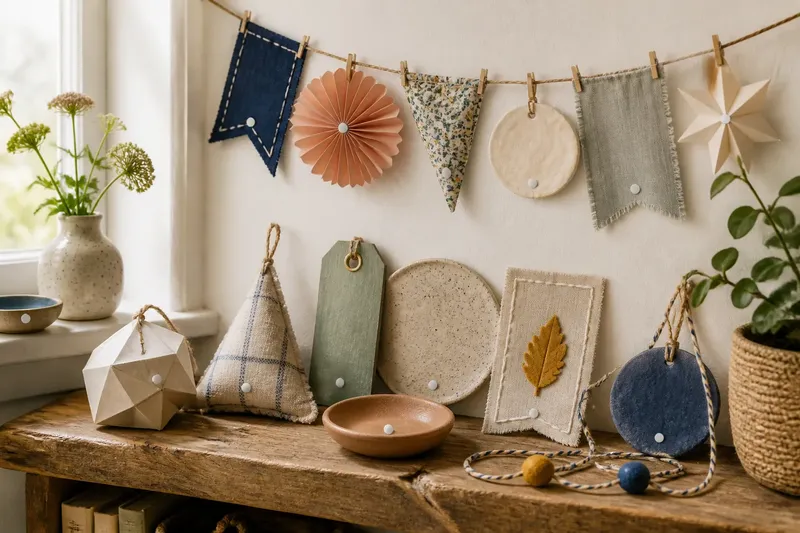
Handmade decor does not need matching colours or shapes to look like a set. A repeated detail—a stitched dash, a painted rim or a small paper star—can tie varied pieces together while letting each one keep its character. The trick is to choose that detail before you start, then repeat it with a light hand.
Why does a matching set feel like the safe choice?
When a group of decorations shares the same colour and outline, the eye reads it quickly as a collection. That can be useful, but it can also make handmade pieces feel more like shop-bought duplicates. Differences in scale, material and finish are often the very things that make a small project worth keeping.
Instead of making every feature agree, give the pieces one dependable point of contact. A consistent border can connect a lopsided clay charm, a folded paper ornament and a scrap-fabric flag without forcing them into the same palette. The shared feature gives the eye a path through the arrangement; the variations give it somewhere to pause.
What should you repeat?
Choose a detail that is easy to recognise and easy to repeat across the materials you plan to use. It should be small enough not to take over, but distinct enough to notice from a short distance. Think of it as a visual refrain, not a uniform.
- A mark: a short painted dash, a dot, or a simple cross-stitch.
- An edge: a narrow border, a scalloped cut, or a line of blanket stitch.
- A motif: a tiny leaf, moon, star or loop.
- A material accent: a length of cotton twine, a brass-coloured eyelet, or a scrap of checked ribbon.
- A placement: a mark near the top corner or a small motif centred along one edge.
Pick one. If you repeat a colour, a motif, a border and a material all at once, you are back to building a matching set by another route. Keep the rest open for variation.
How do you plan a varied group?
Start by gathering the pieces or materials you already have: coloured card, offcuts of fabric, air-dry clay, buttons, string, or whatever suits the project. Lay them out together before cutting or decorating anything. Notice what already differs: perhaps one material is rough, another glossy, and a third carries a bold print.
Now decide what kind of variation you want to keep. You might vary the shapes but use a similar range of sizes, or keep the outlines simple while mixing warm and cool colours. Choosing one area of freedom helps the display feel lively rather than accidental. It is not a rule that every piece must balance another; it is a way to make your first design choices deliberately.
Imagine you have a paper rosette, a fabric flag and a small clay disc for a shelf display. Their colours and outlines are unrelated. You choose a tiny white painted dot as the repeated feature, placing one on each piece where it remains visible. The expected result is a group that still looks varied up close but reads as connected when arranged together.
How can you repeat the detail across different materials?
Test the feature on a spare scrap or an inconspicuous area before committing to a finished piece. A fine line that looks delicate on card may disappear against patterned fabric; a stitched mark may suit cloth better than clay. Keep the underlying idea consistent, but let the technique adapt to the material.
For example, a simple dash might be painted on a wooden tag, sewn with embroidery thread onto felt, and cut as a narrow slit in card. Those marks need not be identical in width or finish. Their shared direction and placement do enough to connect them.
Work through the group one piece at a time, checking that the repeated detail remains visible without becoming the main event. If a busy print swallows it, move the mark to a quieter patch or choose a contrasting thread. If it dominates a plain piece, make it smaller or leave more breathing room around it.
How should you arrange the pieces?
Put the decorations where they will live, rather than judging them only on the worktable. A wall display, a windowsill and a hanging garland each ask for a different rhythm. Arrange the pieces loosely first, then move them until the repeated feature leads the eye across the group without making every gap identical.
Try placing unlike neighbours together. A round piece beside a long one can make both easier to read, while two similarly coloured pieces may benefit from a different texture between them. Turn a piece or swap its position before adding more decoration; sometimes the arrangement, not the object, needs a small adjustment.
Step back, then look closely. From farther away, check whether the shared detail is visible across the collection. Up close, check that each piece still has its own interest. If the set looks too coordinated, remove one repeated mark or let one object be the odd one out.
Which choices help a loose collection feel intentional?
Can the pieces use different colours?
Yes. A repeated shape, edge or placement can link colours that do not match. Let the materials and colours suit the pieces rather than recolouring everything to fit a preset palette.
Does every decoration need the repeated detail?
No. One piece without the shared mark can give the eye a rest and make the motif easier to notice elsewhere. Add the feature to enough pieces for it to register, then judge the balance in the actual arrangement.
What if the materials do not take the same technique?
Keep the visual idea and change how you make it. A painted dash, a stitched dash and a narrow cut can echo one another even though their surfaces feel different.
How do you know when the group is finished?
Stop when the pieces feel related at a glance and individual on closer inspection. If you keep adding matching details to settle every difference, try removing one instead.
How can you avoid overworking the set?
It is tempting to smooth every irregularity once the pieces sit together. Resist the urge to make each edge equally neat or every mark perfectly placed. The repeated feature is there to create a connection, not to erase the signs of handwork.
Use the manufacturer’s instructions for any paints, adhesives or finishes, and follow local guidance where it applies. For a low-fuss project, choose materials that suit the intended display and do not need a complicated finish.
When planning handmade decor, treat the shared feature as a thread rather than a template. Choose one modest detail, repeat it where it helps, and let the rest vary. That approach makes a collection feel considered without asking every piece to look like its neighbour.