Card, Paper or Cloth for a First Collage?
Compare card, paper and cloth for collage by feel, arrangement and visual effect, then choose a surface that suits your materials and first idea.
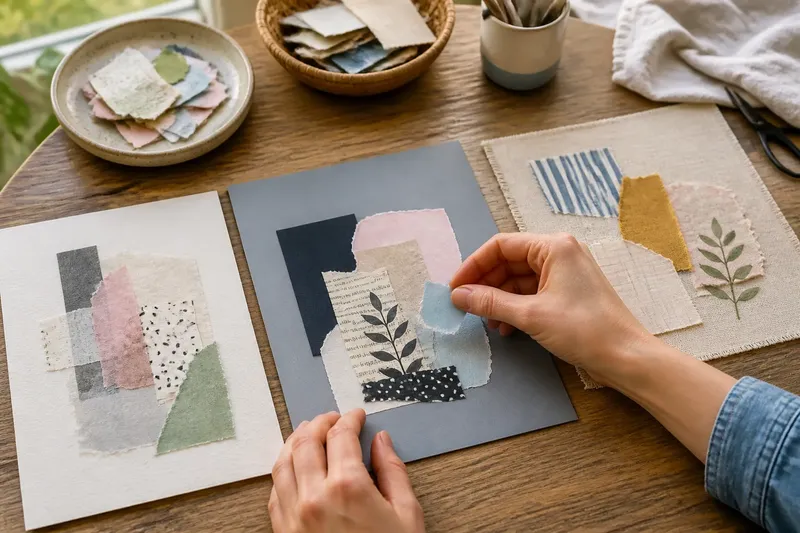
For a first collage, the surface changes how every scrap behaves: card holds its shape, paper keeps the composition light, and cloth brings a soft, irregular edge. Choosing between card, paper or cloth for collage is less about finding the “best” material than deciding what kind of arranging you want to enjoy.
Set the three beside your cut-outs and handle them before reaching for glue. A sheet that feels inviting can make it easier to try a loose arrangement; a firm board may suit a design with crisp edges and heavier pieces. Each surface also changes the look of the same scraps, so your choice is part of the picture, not merely its support.
What does each collage surface feel like?
Card offers resistance under your fingers. It stays flat while you move pieces around, and its firm body makes a satisfying contrast with thin paper or fabric scraps. Some card has a smooth face; other kinds have a fine tooth that catches light and gives the background a quieter texture. It can feel deliberate and substantial, even before the composition is finished.
Paper is more yielding. A piece can curl at the corner, flutter as you lift it, or show a slight ripple once adhesive touches it. That responsiveness is part of its charm: torn edges, translucent layers and small folds can all become visible features. But light paper is also easily nudged out of place, so expect a little more attention during arranging.
Cloth feels soft and tactile, with fibres and weave that remain visible. It may bend rather than sit neatly, and its cut edges can fray. That softness can bring warmth and movement to a collage, while making the whole composition feel less like a flat printed image. Cotton, linen and felt behave differently, too: a woven scrap shows its threads, while felt has a denser, more even surface.
Try the materials dry first. Slide a small scrap across each surface, then lift it. Notice which pairing feels cooperative and which keeps shifting or catching.
How does the surface affect arranging?
Card is often the calmest base for trial and error. It gives scraps a stable place to rest, making it easier to compare spacing, overlap and direction before anything is fixed. If your composition has several small shapes, the firm backing can help preserve the arrangement while you adjust one piece at a time.
Paper invites a lighter touch. A delicate base can make a cluster of thin cut-outs feel airy, but moving the pieces may wrinkle the background or disturb what is already in place. Larger shapes are easier to handle than tiny slivers, and a temporary arrangement on a separate sheet can help you see the overall balance before transferring pieces.
Cloth asks you to allow for movement. A scrap may stretch slightly as you position it, while a loosely woven piece can catch on a rough cut edge. Instead of aiming for perfectly straight rows, let the weave, folds and overlapping seams help determine where pieces sit. A firm cloth such as felt is less floppy than a light woven fabric, but it still gives a different feel from paperboard.
Say you have a few magazine shapes, a printed paper scrap and a small piece of cotton. If you want to shift everything repeatedly as you test a bold, tidy layout, card gives the pieces a steady stage. If you would rather let the cotton overlap a torn edge and soften the arrangement, cloth may make that experiment feel more natural. The visible result is a composition whose order comes either from crisp placement or from the materials’ gentle irregularity.
Which visual effects suit each material?
Card tends to frame a collage. A visible border or uninterrupted background can make the assembled pieces feel like a finished panel. Coloured card can also become a strong part of the design: a warm background may bring out muted scraps, while a dark one can make pale shapes stand apart. Its firmness supports clean silhouettes and clear blocks of colour.
Paper is particularly good at layering. A thin sheet can partly reveal what lies beneath; a torn edge can soften the boundary between one colour and another. Newsprint, tissue and patterned wrapping paper each carry their own marks, so the background need not be blank. When the base itself is delicate, however, a heavy-looking cluster may dominate it rather than blend into it.
Cloth adds texture that is visible and sometimes felt. A strip of checked fabric can introduce a repeating pattern, while a plain weave can break up a field of smooth paper. Frayed edges suggest looseness; neat cuts create a more contained look. Fabric scraps can make shapes seem softer, but a bold weave may also draw the eye away from small details.
Think about contrast in more than colour. Smooth against rough, opaque against sheer, and sharp against frayed are all useful pairings. A collage made from only glossy paper may look lively through colour but uniform in texture; adding one matte or woven piece can give the eye somewhere else to pause.
What should you consider before choosing?
Start with the pieces you already want to use. Thin tissue, lightweight printed paper and small cut-outs are easy to place on card, while a paper base can make similar materials feel especially delicate. Fabric scraps may sit more comfortably with a cloth surface, though a single textile patch can also make a striking accent on card or paper.
Then consider how much you want the background to show. If it is meant to be an active part of the image, choose a colour or texture that belongs in the composition. If the scraps should carry most of the attention, a quieter surface may help them stand out. A busy printed base and busy cut-outs can compete unless their colours or patterns have a clear relationship.
Size and handling matter as well. A small collage that will be moved around the table benefits from a base that stays reasonably firm. A broad, loose arrangement can make use of paper’s flexibility or cloth’s drape. There is no need to force one material into every role: a firm backing with a paper or fabric layer can combine steadiness with texture.
Before applying adhesive, check that the surface and scraps are compatible with the product and with the way you want to work. Follow the adhesive and material makers’ directions, since some combinations may wrinkle, stain or fail to bond as expected.
How do you decide between card, paper and cloth?
Is card easier for a first collage?
Card can be easier to arrange on because it stays firm while you move pieces, especially when your design uses small shapes or crisp overlaps. Its stiffness does not make every project simpler, though: a very heavy or textured card can be awkward to cut neatly.
Can ordinary paper work as a collage base?
Yes, paper can work well when you want a light, layered look or enjoy torn edges and translucent pieces. Choose a base that feels sturdy enough for the scraps you plan to add, and handle it gently so the surface does not buckle while you compose.
Does cloth make collage too difficult for beginners?
Cloth is manageable if you welcome its softer, less exact character. A stable piece such as felt can be easier to place than a slippery or loosely woven fabric, while visible fibres and imperfect edges can contribute to the finished image.
Can I combine all three surfaces?
You can combine them if their textures support the composition rather than crowd it. For instance, a card base can hold paper shapes and one cloth accent, creating a clear contrast between smooth, printed and woven areas.
What makes a satisfying first choice?
Choose by the kind of decision you want to make at the table. Card favours deliberate placement and a composed, panel-like result. Paper rewards layering and delicate edges. Cloth brings tactility, visible weave and a willingness to let the materials look a little less exact.
If you are torn, make a small dry arrangement on each surface before committing. Use the same handful of scraps and compare how they sit, how much the background shows and which pairing makes you curious to keep moving things. That simple comparison is often more useful than choosing by a material’s name alone.
For a first collage, card, paper or cloth can each be the right surface, provided its behaviour suits the play you have in mind. Keep one extra scrap nearby as a test piece, and let the first arrangement teach you what you want to try next.