A Rainy Afternoon, Turned into a Paper Playground
A paper playground turns scrap into a shared tabletop landscape, with simple choices for different ages, moods and amounts of space.
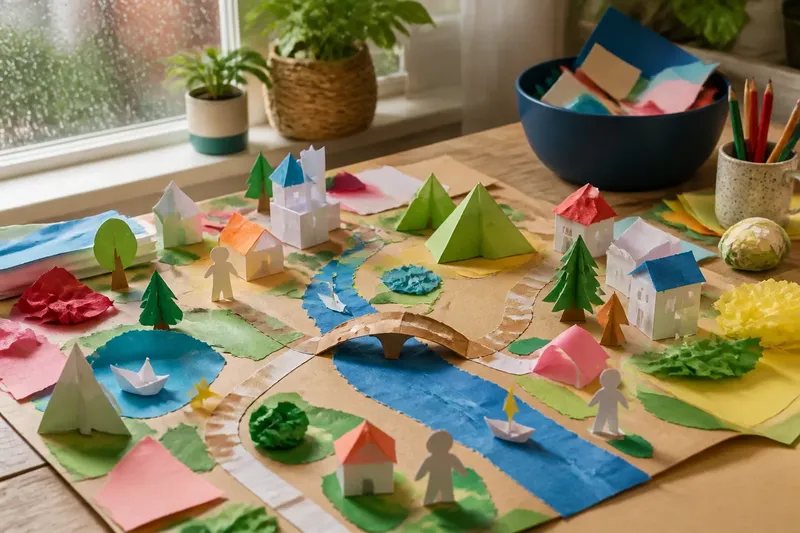
A paper playground needs no picture to copy: it begins with a clear patch of table, a handful of scraps and permission for the landscape to change. For a rainy afternoon, that freedom is the point. Fold a strip into a bridge, tear a blue edge into a river, or shift the whole scene when someone has a better idea.
What sort of afternoon are you having?
Choose the session to suit the people and the room, not an imagined finished display. The same pile of paper can become a quiet solo world or a busy shared map.
- For a calm, low-energy hour: Make a small landscape with a few colours and let each person add one feature at a time. The slower pace gives room for noticing textures and revising ideas.
- For mixed ages: Put out easy-to-tear paper and invite different kinds of contribution. One person can make broad shapes while another adds tiny paths or signs; nobody needs matching skills.
- For a crowded table: Work on a sheet of scrap cardboard or the back of wrapping paper. It gives the scene a boundary that can be moved aside between turns.
- For an energetic group: Let the landscape grow by turns, with each person adding something that connects to an existing feature. A paper road might lead to a folded hill, which might prompt a station.
If attention is likely to wander, make the activity easy to rejoin: leave the scraps visible and keep the scene open-ended.
Which scraps make the best landscape?
Use what is already at hand: envelopes, old drawings, paper bags, coloured offcuts, tissue paper or the blank backs of unwanted printouts. A mix of surfaces makes the landscape more interesting than a carefully matched palette. Keep any paper with private details out of the pile, and skip pieces that are dirty or unpleasant to handle.
Choose a base that suits the space. A piece of cardboard is easy to carry; a large sheet of paper gives the group more room to spread out. On a small table, a placemat-sized area can still hold a whole imaginary place if everyone is willing to build upwards with folds and layers.
Set out blunt-ended scissors only if the group can use them safely; tearing works just as well for coastlines, clouds and rough-edged fields. A glue stick is optional. Leaving pieces loose makes it much easier to rearrange the scene, while a little tape can keep a bridge or tower standing when it matters to the players.
How can the paper become a place?
Start with shapes that suggest possibilities rather than naming every feature in advance. A long strip can be a path, a narrow fold can stand like a ridge, and a torn circle can become a pond or a moon. Invite people to say what they see, but let the maker decide what a piece means.
Try a simple rhythm: add, connect, then move. Someone places a shape; another links it to the landscape with a road, stream or trail; then the group can shift any loose pieces that make the scene more inviting. This keeps the play collaborative without turning it into a contest over who owns each part.
Imagine two siblings begin with a sheet of brown packing paper and a few coloured envelopes. One tears a winding blue strip for a river, and the other folds a green scrap into a hill beside it; when they decide the river needs a crossing, they add a loose paper bridge. The visible result is a connected scene they can keep changing, not a model that has to look finished.
What if the group wants different things?
Different ideas can share the same table. Instead of settling every disagreement, let the landscape hold two versions: a town on one side and a wild forest on the other, joined by a path that someone can travel. Or give a disputed feature a new identity. A folded piece that looks like a mountain to one person might be a sleeping creature to another.
For a child who prefers arranging to inventing stories, offer a few gentle prompts: “Where could someone rest?” or “What might be hidden behind that fold?” For a child who likes narrative, let them make a character from a scrap and send it across the scene. Adults can contribute too, but asking before altering someone else’s piece keeps the shared play welcoming.
If the table becomes crowded, move pieces rather than adding more. A landscape often gains clarity when a few loose shapes are taken away and saved for a new corner.
Which approach fits your materials and mood?
Can you make a paper landscape without glue?
Yes. Loose scraps are ideal when the scene is meant to change, and folded edges or overlapping shapes can help pieces stay in place. Use tape only where a wobbly structure is getting in the way of play.
What can you do with only plain paper?
Use folds, tears and layers to make contrast: a flat piece can be a field, while an upright fold becomes a wall or hill. Add names aloud, or draw simple paths and marks with a pencil if one is nearby.
How do you adapt the activity for a small table?
Choose a compact base and build one connected neighbourhood at a time. Keep spare scraps in a bowl or envelope so the working area stays clear and people can swap pieces without crowding the scene.
How can you stop the activity feeling like a craft lesson?
Leave the final design undecided and avoid correcting someone’s interpretation of a shape. Ask what could happen next, then let the group answer through another fold, tear or rearrangement.
How should the playground end?
There is no need to preserve every creation. Before clearing the table, ask whether anyone wants to keep a small feature, take a photograph for personal reference or simply enjoy the last view of the scene. A cardboard base can be slid onto a shelf if the group wants to return to the play later.
For a tidy finish, sort reusable scraps back into their original pile and recycle clean paper according to local guidance. Keep anything taped or glued together only if it has a clear purpose; otherwise, the loose pieces are ready for another afternoon.
The best paper playground is the one that gives each person an easy way in. Leave a few inviting scraps within reach, and the next story can begin before the rain stops.